
I like to describe it as the golden triangle situated within a 1 to 2-hour drive south-west of Melbourne.
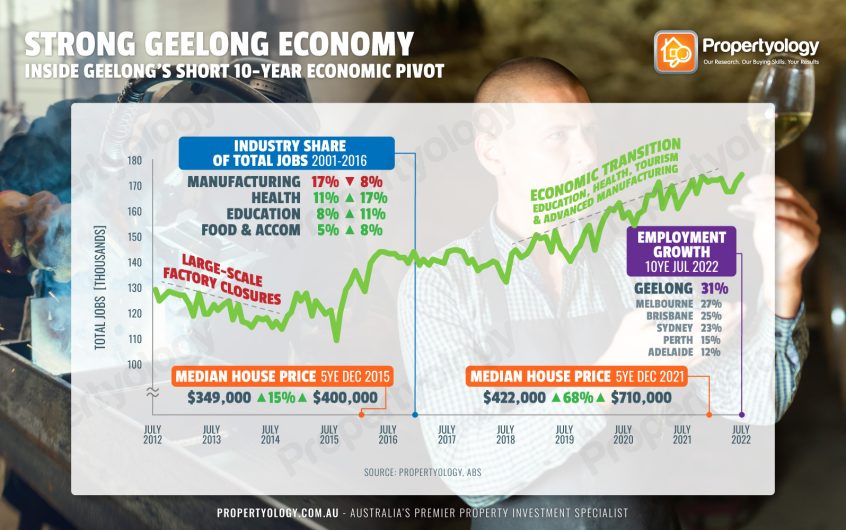
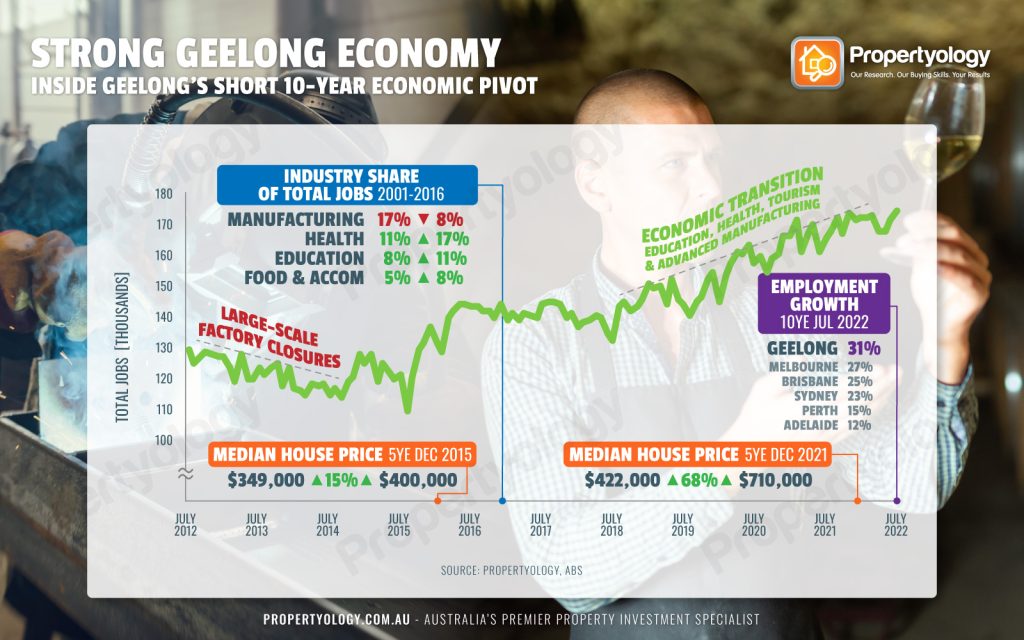
Australia’s 10th largest of 400 townships, Geelong’s remarkable success over the last 10-years is reflected in higher growth rates for both total job volumes and total population than 8 out of 8 capital cities.
Strong economic growth plus the high quality (and diversity) of lifestyle offerings have attracted 45,000 (net) new residents from internal migration to Geelong and its neighbouring municipalities over the last decade.
Geelong’s property market was so strong that the median house price doubled over the decade. And the average annual capital growth rate over the last 20-years is superior to 7 out of 8 capital cities.
A standard house in Geelong today is worth circa $800,000.
The increased demand for housing has also added 20 percent to the asking price to rent a standard house.
Promoting the region’s idyllic lifestyle has become part of a very clever recruitment and retention strategy which now sees the 2022 AFL Premiers, Geelong Football Club, the envy of all Australian elite sports.
In addition to the very strong sense of community, the ocean, rural landscapes, wineries, quality restaurants, umpteen cultural experiences and the arts are all within a 30-minute drive of Geelong’s city centre.
It does not have the congestion and stresses of capital cities, but a population of 270,000 people is plenty of substance.
The beautiful Corio Bay was the destination for Geelong’s first colonial settlement in 1838. Land sales commenced a year later.
In the Gold Rush of the 1850’s, Geelong played an important role in exporting the valuable metal from Bendigo and Ballarat.
Directly after the completion of World War 1, Ford Australia was founded in Geelong in 1922. A few years later, Target opened its first ever drapery store. And urban development in the Surf Coast and Great Ocean Road districts also commenced in the 1920’s.
Industrial growth continued to be relatively strong through to the 1960’s before a series of significant economic hits over the next half century.
High tariffs contributed to the closure of the region’s wool industry in the 1970’s, leaving hectares of factories and warehouses empty and large-scale job loss.
The early 1990’s was incredibly challenging and saw Geelong’s unemployment rate exceed 10 percent.
As if that was not enough, Pyramid Building Society, founded in Geelong in 1959, also went under, leaving more than 200,000 deposit holders with more than $1.3 billion in debt.
Consequently, Geelong real estate values completely flatlined with the same ($96,000) median house price in 1990 to 1997.
The 5-years ending 2016 saw the closure of several major employers, including Ford car manufacturing, Shell oil refinery, Alcoa aluminium smelter and Target Australia’s headquarters relocation. Approximately 2,500 direct jobs were lost and even more indirect jobs.
Approximately 10,000 students are enrolled across two Deakin University campuses, including the beautiful conversion of a collection of former wool stores into a modern learning space overlooking Corio Bay.
Consequently, Geelong’s demographic has become more diversified with a smaller ratio in the over 65yo and trade labour brackets. Understandably, Geelong birth rates have also increased in recent years.
The evolution of the Avalon Airport, located 15-minutes north of town, must not be underestimated.
Founded in 1953, the then government-owned facility originally focused on manufacturing light aircraft. Privatisation of the infrastructure in 1995 became the trigger for commercial flights.
The real gamechanger occurred when national transport logistics giant, Linfox, purchased the airport in 1997. Since then, over $100 million has been invested in infrastructure upgrades, including construction of a new terminal in 2013 and runway capacity capable of fitting an Airbus A380.
Jetstar became a carrier in 2004 while international flights commenced in 2018. It was an important part of the economic growth.
Within the less than 2-decades, Avalon Airport’s expansion meant it was servicing more than 1 million passengers annually directly prior to the pandemic (domestic and international combined).
But Geelong’s roots will always be front and centre, perhaps no more glaringly than the city’s port which now manages 600 vessel visits and $7 billion in trade per year.
Despite all of the adversity, the city’s population growth of 121 percent over the last 50-years is superior to the national average of 95 percent.
The one constant for the region throughout the last 163-years was the Geelong AFL team, officially Australia’s second oldest football club and the most successful elite-level team of all sports over the last 15-years.
72,000 paid-up members, a majority of whom live in Geelong, and countless other casual supporters is a compelling common purpose for a community of 270,000.
After breaking a 44-year premiership drought in 2007, the sustained success of the Geelong AFL team over the last 15-years is unrivalled in this country. 4x premierships, 2x runner ups and 12x Top 4 finishes across 15-years is next-level elite.
The region’s idyllic lifestyle, relatively affordable housing and work-life-balance ethos are now proven X-factors which help to attract and retain AFL athletes in a similar way to 45,000 residents of the general public that relocated over the last decade.
Over the last decade, more than $200 million has been invested in upgrades to Geelong AFL’s stadium, which is proudly sponsored by national health care and insurer, GMHBA, whose headquarters is in Geelong.
Detached houses are very much the real estate of choice in Geelong. According to the 2021 Census, 86 percent of the 102,000 residential dwellings in Greater-Geelong were houses.
83 percent of the 26,530 new dwellings approved for construction over the last decade were detached houses.
The Werribee Open-Range Zoo, Bannockburn wine district, beautiful rural settings (beef, lamb, wool, fruit and vegetables) and the world-renowned Great Ocean Road (surfing, fishing and idyllic holidays) are all within about 45-minutes of the Geelong CBD.
Commuters have the option of efficient highways, regular trains ($3.6 billion Regional Rail Link was completed in 2015) or ferry services from Corio Bay to Docklands.
For example, Tom Hawkins, the incumbent AFL All Australian captain, lives 20-minutes west of town on a rural property at Barrabool where he breeds angus beef.
50 kilometres south of Geelong is the municipality of Surf Coast – Great Ocean Road country. The median house price here has doubled over the last 5-years to a lofty $1.5 million. In 2015, Brownlow medalist and 8-time All Australian representative, Patrick Dangerfield relocated from Adelaide to here to join Geelong AFL and whet his fishing appetite from the seaside hamlet of Moggs Creek.
Just 15-kilometres inland from Torquay and Bells Beach is the township of Modewarre. The development of a $350 million elite sports hub and wellness centre could soon see visits from the likes of Manchester United, Real Madrid, Indian Premier League cricket teams and American NBA teams.
Source: Propertyology